Beyond the Headlines: What's wrong with the UK's Rwanda refugee plan?


James Haines-Young
  • English
  • Arabic

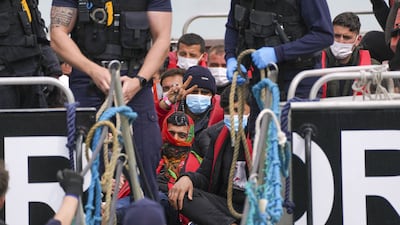
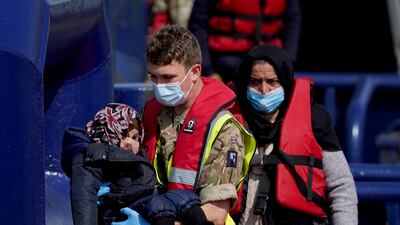
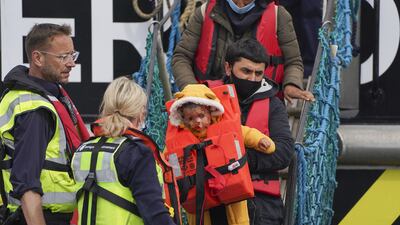
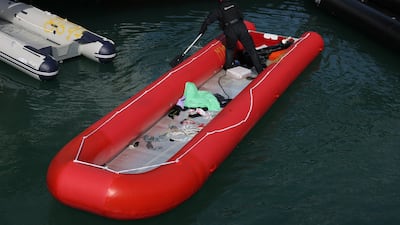
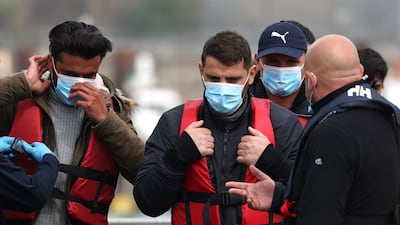
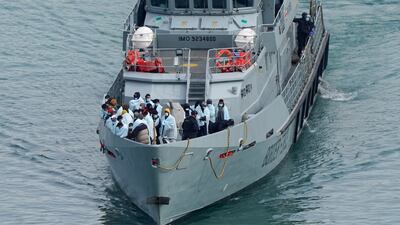
Rescued from the choppy seas of the English Channel or landing on the windswept beaches of the east of England, over the last three years thousands of people in small inflatable dinghies have made the perilous crossing from France.

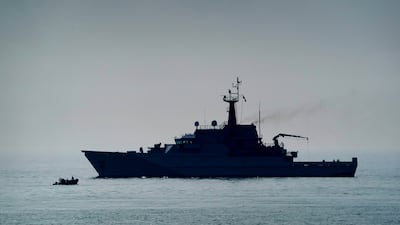
As dozens died making the journey, the UK deployed the coastguard, the navy and the lifeboat service to try to rescue those attempting to make the journey.

In 2021, an estimated 28,526 people crossed the channel in small boats. Data for the first half of 2022 showed over 8,000 had made the journey with tens of thousands more expected in the calmer, warmer summer months.

The arrivals have sparked a heated debate.

Some accuse the government of being soft on immigration, turning a blind eye to smugglers and not policing the country’s borders.

Others accuse the government of a callous disregard for human life and failing to meet obligations to those fleeing for their lives.

And now, the UK has said “enough”.

On this week's Beyond the Headlines, host James Haines-Young delves into the UK Government’s plan to send asylum seekers to Rwanda, we look at the criticism of the proposal from even the most vocal advocates for significant action and ask whether such proposals can even solve the issue.

Who was Alfred Nobel?

The Nobel Prize was created by wealthy Swedish chemist and entrepreneur Alfred Nobel.

  • In his will he dictated that the bulk of his estate should be used to fund "prizes to those who, during the preceding year, have conferred the greatest benefit to humankind".
  • Nobel is best known as the inventor of dynamite, but also wrote poetry and drama and could speak Russian, French, English and German by the age of 17. The five original prize categories reflect the interests closest to his heart.
  • Nobel died in 1896 but it took until 1901, following a legal battle over his will, before the first prizes were awarded.
Match info:

Burnley 0

Manchester United 2
Lukaku (22', 44')

Red card: Marcus Rashford (Man United)

Man of the match: Romelu Lukaku (Manchester United)

Super Bowl LIII schedule

What Super Bowl LIII

Who is playing New England Patriots v Los Angeles Rams

Where Mercedes-Benz Stadium in Atlanta, United States

When Sunday (start time is 3.30am on Monday UAE time)


Frankenstein in Baghdad
Ahmed Saadawi
​​​​​​​Penguin Press

UAE currency: the story behind the money in your pockets
Results

6.30pm: Dubai Millennium Stakes Group Three US$200,000 (Turf) 2,000m; Winner: Ghaiyyath, William Buick (jockey), Charlie Appleby (trainer).

7.05pm: Handicap $135,000 (T) 1,600m; Winner: Cliffs Of Capri, Tadhg O’Shea, Jamie Osborne.

7.40pm: UAE Oaks Group Three $250,000 (Dirt) 1,900m; Winner: Down On Da Bayou, Mickael Barzalona, Salem bin Ghadayer.

8.15pm: Zabeel Mile Group Two $250,000 (T) 1,600m; Winner: Zakouski, James Doyle, Charlie Appleby.

8.50pm: Meydan Sprint Group Two $250,000 (T) 1,000m; Winner: Waady, Jim Crowley, Doug Watson.

Mercer, the investment consulting arm of US services company Marsh & McLennan, expects its wealth division to at least double its assets under management (AUM) in the Middle East as wealth in the region continues to grow despite economic headwinds, a company official said.

Mercer Wealth, which globally has $160 billion in AUM, plans to boost its AUM in the region to $2-$3bn in the next 2-3 years from the present $1bn, said Yasir AbuShaban, a Dubai-based principal with Mercer Wealth.

Within the next two to three years, we are looking at reaching $2 to $3 billion as a conservative estimate and we do see an opportunity to do so,” said Mr AbuShaban.

Mercer does not directly make investments, but allocates clients’ money they have discretion to, to professional asset managers. They also provide advice to clients.

“We have buying power. We can negotiate on their (client’s) behalf with asset managers to provide them lower fees than they otherwise would have to get on their own,” he added.

Mercer Wealth’s clients include sovereign wealth funds, family offices, and insurance companies among others.

From its office in Dubai, Mercer also looks after Africa, India and Turkey, where they also see opportunity for growth.

Wealth creation in Middle East and Africa (MEA) grew 8.5 per cent to $8.1 trillion last year from $7.5tn in 2015, higher than last year’s global average of 6 per cent and the second-highest growth in a region after Asia-Pacific which grew 9.9 per cent, according to consultancy Boston Consulting Group (BCG). In the region, where wealth grew just 1.9 per cent in 2015 compared with 2014, a pickup in oil prices has helped in wealth generation.

BCG is forecasting MEA wealth will rise to $12tn by 2021, growing at an annual average of 8 per cent.

Drivers of wealth generation in the region will be split evenly between new wealth creation and growth of performance of existing assets, according to BCG.

Another general trend in the region is clients’ looking for a comprehensive approach to investing, according to Mr AbuShaban.

“Institutional investors or some of the families are seeing a slowdown in the available capital they have to invest and in that sense they are looking at optimizing the way they manage their portfolios and making sure they are not investing haphazardly and different parts of their investment are working together,” said Mr AbuShaban.

Some clients also have a higher appetite for risk, given the low interest-rate environment that does not provide enough yield for some institutional investors. These clients are keen to invest in illiquid assets, such as private equity and infrastructure.

“What we have seen is a desire for higher returns in what has been a low-return environment specifically in various fixed income or bonds,” he said.

“In this environment, we have seen a de facto increase in the risk that clients are taking in things like illiquid investments, private equity investments, infrastructure and private debt, those kind of investments were higher illiquidity results in incrementally higher returns.”

The Abu Dhabi Investment Authority, one of the largest sovereign wealth funds, said in its 2016 report that has gradually increased its exposure in direct private equity and private credit transactions, mainly in Asian markets and especially in China and India. The authority’s private equity department focused on structured equities owing to “their defensive characteristics.”

Who's who in Yemen conflict

Houthis: Iran-backed rebels who occupy Sanaa and run unrecognised government

Yemeni government: Exiled government in Aden led by eight-member Presidential Leadership Council

Southern Transitional Council: Faction in Yemeni government that seeks autonomy for the south

Habrish 'rebels': Tribal-backed forces feuding with STC over control of oil in government territory

How to watch Ireland v Pakistan in UAE

When: The one-off Test starts on Friday, May 11
What time: Each day’s play is scheduled to start at 2pm UAE time.
TV: The match will be broadcast on OSN Sports Cricket HD. Subscribers to the channel can also stream the action live on OSN Play.

Farage on Muslim Brotherhood

Nigel Farage told Reform's annual conference that the party will proscribe the Muslim Brotherhood if he becomes Prime Minister.
"We will stop dangerous organisations with links to terrorism operating in our country," he said. "Quite why we've been so gutless about this – both Labour and Conservative – I don't know.
“All across the Middle East, countries have banned and proscribed the Muslim Brotherhood as a dangerous organisation. We will do the very same.”
It is 10 years since a ground-breaking report into the Muslim Brotherhood by Sir John Jenkins.
Among the former diplomat's findings was an assessment that “the use of extreme violence in the pursuit of the perfect Islamic society” has “never been institutionally disowned” by the movement.
The prime minister at the time, David Cameron, who commissioned the report, said membership or association with the Muslim Brotherhood was a "possible indicator of extremism" but it would not be banned.

What vitamins do we know are beneficial for living in the UAE

Vitamin D: Highly relevant in the UAE due to limited sun exposure; supports bone health, immunity and mood.Vitamin B12: Important for nerve health and energy production, especially for vegetarians, vegans and individuals with absorption issues.Iron: Useful only when deficiency or anaemia is confirmed; helps reduce fatigue and support immunity.Omega-3 (EPA/DHA): Supports heart health and reduces inflammation, especially for those who consume little fish.

Updated: April 29, 2022, 3:00 PM
More podcasts